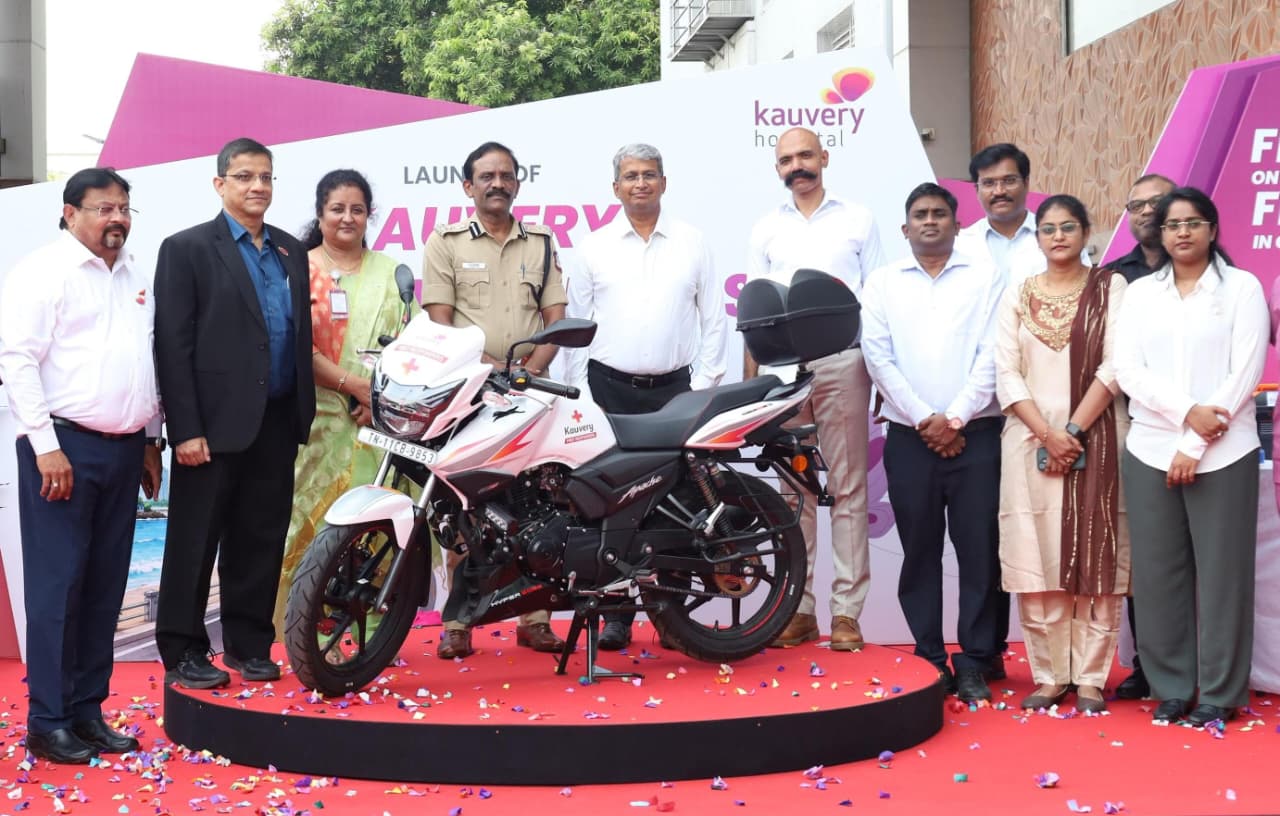
Chennai, September 21, 2026: Kauvery Hospital has launched Kauvery First Responders, a network of bike ambulances across Chennai aimed at bringing trained medical first responders and essential emergency equipment closer to patients at the critical first moments of an emergency. Operated by trained medical responders, the bikes are designed to reach emergency scenes quickly, assess patients and provide appropriate first-response care within established training and protocols, while simultaneously coordinating with the hospital and conventional ambulance services for timely further management and transportation.
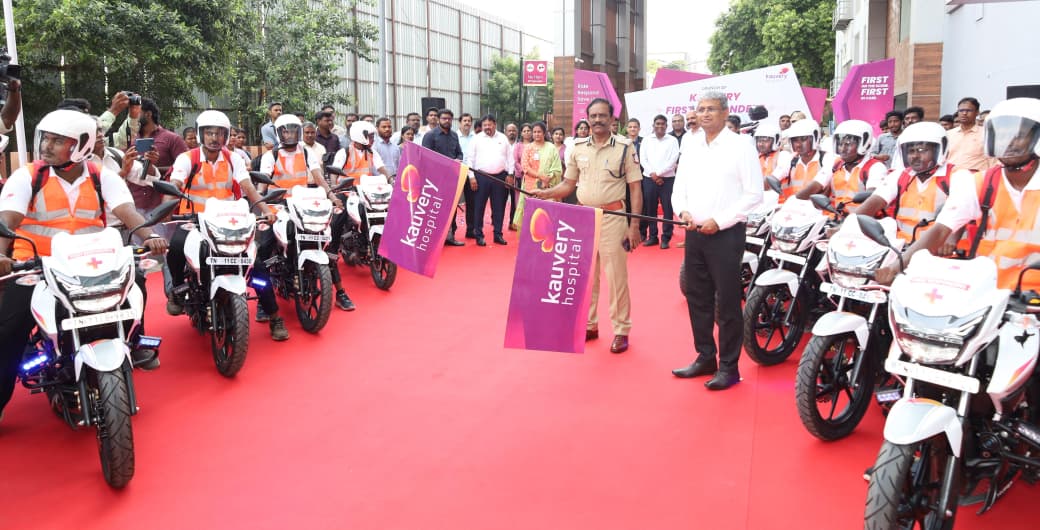 Thiru P. Pakalavan, IPS, Joint Commissioner of Police (Traffic – South), Chennai, participated in the event as the Chief Guest.
In the first phase, 10 bike ambulances have been deployed across Kauvery Hospital’s Chennai network, covering its Alwarpet, Vadapalani, Radial Road and Maa Kauvery locations. The network is designed to extend rapid emergency support across different parts of the city, particularly in situations where traffic congestion or road accessibility may delay the movement of larger emergency vehicles.
The bike ambulances are not intended for patient transport. Their role is to bring trained medical expertise and essential emergency support to the patient while a conventional ambulance is coordinated for further management and transportation, when required. Each First Responder bike is equipped with essential emergency-response equipment, including an Automated External Defibrillator (AED), oxygen support and an emergency medical kit.
In a suspected cardiac arrest, for instance, the AED can analyse the patient’s heart rhythm and deliver an electrical shock when indicated. Oxygen can be administered when clinically appropriate, while the emergency medical kit enables the responder to carry out immediate assessment and provide first-response care in accordance with established protocols.
The First Responders also function as part of a connected emergency-care system. Equipped with 5G connectivity, webcams and GPS/live tracking, the responder can stay connected with the hospital team while at the scene, enabling real-time coordination and facilitating the transition to further care when the patient is transported to the hospital. People can contact the hospital’s emergency care at 044-40006000.
In his comments, Dr. Manivannan Selvaraj, Founder & Managing Director, Kauvery Group of Hospitals, said, “In an emergency, reaching the patient is the first challenge, and in a city like Chennai, traffic can sometimes make that challenge even greater. We wanted to create a system that works around this reality and brings medical assistance closer to the point where it is needed. Kauvery First Responders are designed to put trained medical responders and essential emergency equipment on the road, so that appropriate care can begin at the scene while the ambulance and hospital teams coordinate the next stage. It is not about replacing the ambulance; it is about making sure that the wait for an ambulance does not also mean a wait for the first response.”
Dr. Aravindan Selvaraj, Co-Founder & Executive Director, Kauvery Group of Hospitals, said: “Emergency care is not only about how quickly we reach a patient, but also about what happens in those first few minutes. A faster response becomes meaningful when it is backed by trained personnel, the right equipment and a connected clinical system. With Kauvery First Responders, we are extending the emergency-care pathway beyond the hospital and bringing that first point of clinical response closer to the community. The combination of mobility, emergency preparedness and real-time connectivity can help our teams make those early minutes more purposeful, while ensuring that the patient remains connected to the larger continuum of care.”
Kauvery Hospital already operates a connected emergency ambulance network in Chennai, with 5G-enabled ambulances supporting real-time patient monitoring and remote clinical guidance during transport. The First Responders add another layer to this emergency-care pathway, bringing the response even closer to the point where the eme